What If Growers Graded the Papers? A Case for Farmer Review of Agronomic Preprints
Photo: Osama Shukir Muhammed Amin FRCP(Glasg), CC BY-SA 4.0, via Wikimedia Commons
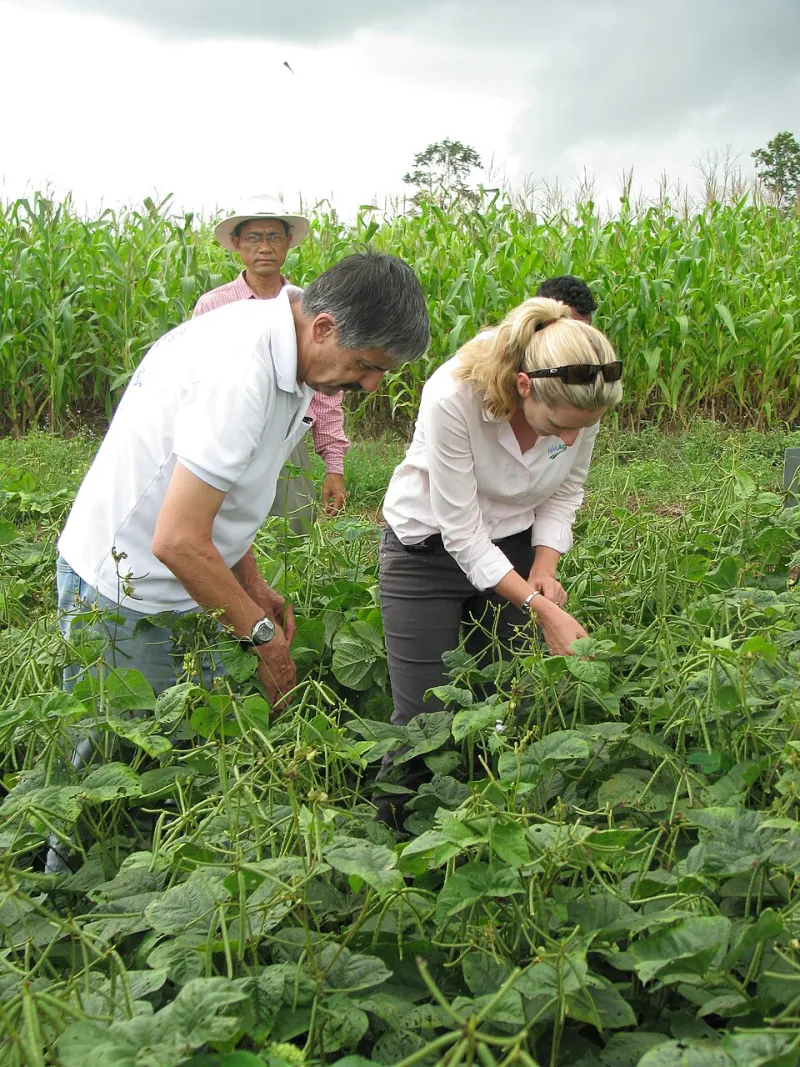
Peer review rests on a quiet fiction: that the best judge of whether an agronomic finding will hold up is another academic who runs plots on a research farm. But agronomy is unusual among sciences in that its claims are tested annually, at scale, by tens of thousands of practitioners who have no PhD and no journal affiliation. A cover-crop study validated across four university fields means something different once it faces 400,000 acres of variable soil, hired labor, and a wet harvest. The growers are, in a very real sense, the field's most rigorous reviewers — they simply have never been invited to sign the report.
It is time to change that. Agricultural preprint servers should build a formal mechanism for grower review: structured, attributed commentary from working farmers on preprints that make claims relevant to production agriculture. This is not a gimmick. It is an experiment worth running deliberately, with eyes open to both the promise and the failure modes.
Why the Current System Leaks Credibility
The traditional review pipeline for agronomy is slow, and the lag is not evenly distributed in its consequences. By the time a study on a novel biological inoculant, a tillage alternative, or an integrated pest-management tactic clears review and lands behind a paywall, two growing seasons may have passed. In the interim, the claim travels anyway — through field days, dealer conversations, and social media — stripped of its caveats and its sample sizes alike.
Farmers are already evaluating this research informally. The problem is that their evaluations vanish. A grower in central Illinois who plants a split-field trial after reading a preprint generates exactly the kind of real-world validation data that reviewers sitting in offices cannot. Today, that observation dies in the combine's cab. A formal farmer-review layer would capture it, attach it to the paper, and make it visible to the next grower — and to the authors.
What Structured Grower Review Could Look Like
The design matters. Unmoderated comment sections devolve into noise, and agriculture is not exempt from the misinformation dynamics that plague every other domain online. A credible system would borrow from what has worked elsewhere.
Commentary should be structured around specific claims: Does this yield response match what you observed? Were the input costs accounted for? Does the protocol assume labor or equipment that a mid-sized operation does not have? Reviewers would be verified — through cooperative memberships, extension connections, or farm registration — and their comments attributed and archived, so that a grower's track record of substantive feedback accrues visible standing over time.
Flagging is as important as praise. A preprint whose recommendations fail on heavy clay soils in the Red River Valley, or whose economics collapse at realistic custom rates, should carry that signal early. Authors, in turn, get something journals rarely provide: rapid, distributed replication across conditions no single research program could ever cover.
The Risks We Should Not Pretend Away
The objections are serious and deserve honest treatment. The first is pseudoscience. Any open commentary system invites anecdotes dressed as evidence, and a flag from a credible-sounding grower could lend weight to claims that have not survived actual scrutiny. The mitigation is not exclusion but labeling: grower commentary must be clearly distinguished from expert review, framed as experiential validation rather than confirmation, and never allowed to substitute for methodological assessment.
The second risk is capture. Input suppliers and agtech marketers have every incentive to co-opt a farmer-review badge as a marketing tool. Governance — verified identity, conflict-of-interest disclosure, and independence from sponsorship — will determine whether the system builds trust or squanders it.
The third risk is burden. Farmers are not volunteers for the publishing industry. Participation must be lightweight, mobile-first, and genuinely reciprocal — ideally structured so that growers who contribute commentary gain early access to findings relevant to their operations.
An Experiment Worth Running
None of this argues for abandoning traditional peer review. Methodological rigor requires trained eyes. But rigor and relevance are different virtues, and agronomy has historically been rich in the former and starved of the latter at the point of publication.
The proposal, in short: select a set of preprints making production-relevant claims, invite verified growers to submit structured commentary, publish that commentary as a permanent, attributed layer on the paper, and evaluate honestly after three years. Did grower flags predict findings that later formal replication confirmed or overturned? Did authors revise in response? Did growers trust and use the system?
Agricultural science asks the public to fund its research and then asks farmers to bet their livelihoods on its conclusions. Granting growers a formal voice in evaluating those conclusions is not a radical departure from scientific norms. It may be the most natural extension of them.