Downloaded, Debated, or Ignored? What Usage Data Reveals About Agricultural Preprints That Actually Reach the Field
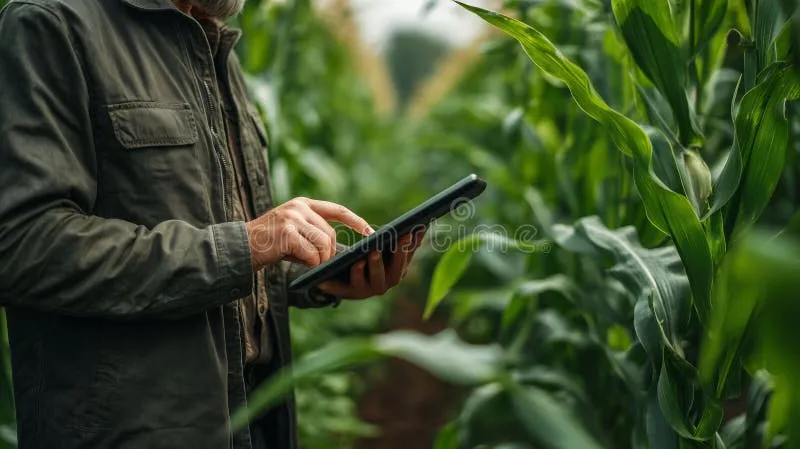
Photo: farmer reading tablet data in corn field, via thumbs.dreamstime.com
Agricultural preprints remain a small corner of the open-science landscape, and the usage data reflects it. The median working paper in agronomy posted to an open repository is downloaded a few hundred times, cited rarely, and read almost exclusively by other academics. But the distribution has a long tail, and at its far end sit preprints that commodity groups forwarded to their members, that state agencies cited in rulemaking comments, and that county educators turned into slide decks within weeks.
What separates the two groups? Drawing on repository download statistics and conversations with agronomists whose working papers traveled well beyond campus, a consistent pattern emerges.
1. They Lead With the Decision, Not the Discovery
The preprints that reach farmers and policymakers open with the question a practitioner is actually asking: Should I switch my fungicide timing? Will this cover crop pencil out under a new insurance rule? Papers that open with a methodological contribution — however sound — tend to circulate only within the subdiscipline that shares the method.
2. They Name Their Non-Academic Audience Early
Authors who wrote a single paragraph identifying which grower group, agency, or industry decision their findings bore on saw measurably broader downloads, particularly from government IP ranges. Search engines and institutional newsletters both reward explicit framing; a preprint titled around a specific policy question gets picked up in agency literature scans that a generically titled paper never enters.
3. They Publish an Accessible Companion Summary
The single most common habit among highly circulated authors: a plain-language, one-page summary posted alongside the working paper. Extension educators, trade journalists, and commodity staff routinely excerpt these summaries rather than translate dense manuscripts themselves. Authors who skipped this step reported their papers 'stalled at the agronomist layer' — read by peers, never forwarded downstream.
4. They Time Release to the Production Calendar
Agronomy has a rhythm. A preprint on planting-date effects posted in February, ahead of spring decision-making, reaches practitioners when the question is live. The same paper posted in October competes with harvest for attention and waits eleven months for its audience to return. Several authors described deliberately holding completed manuscripts until the relevant season approached.
5. They Court the Intermediaries
Farmers rarely read preprints; they read what extension educators, crop consultants, and commodity newsletters tell them about preprints. Authors who personally emailed thirty educators and consultants — not blast emails, but individual notes — consistently reported orders-of-magnitude differences in downstream reach. The intermediaries, not the end audience, are the real distribution network.
6. They Include the Economic Arithmetic
Agronomic findings without a cost layer rarely change behavior. Working papers that attached even a simple partial-budget analysis — what the practice costs per acre against expected yield or input savings — were disproportionately cited in farm-press coverage and policy testimony. Yield effects alone, several authors noted, are treated as interesting; dollar effects are treated as actionable.
7. They Treat Versioning as an Asset, Not an Embarrassment
Finally, the most-read preprints were revised in public. Updated versions incorporating grower feedback from field days, corrected estimates, and appended regional data drew repeat traffic and, crucially, signaled responsiveness. Readers outside the academy interpreted visible revision as a mark of seriousness — the opposite of the common fear that posting early exposes imperfection.
The Common Thread
None of these habits requires new tools. They require treating a preprint not as a journal article that arrived early, but as a distinct genre with its own audience, calendar, and distribution system. The agricultural working papers that matter beyond the academy were written for the field from the first sentence — and the download data shows it.