Counties Beyond the County Agent: Mapping America's Extension Deserts and the Case for Open Research Delivery
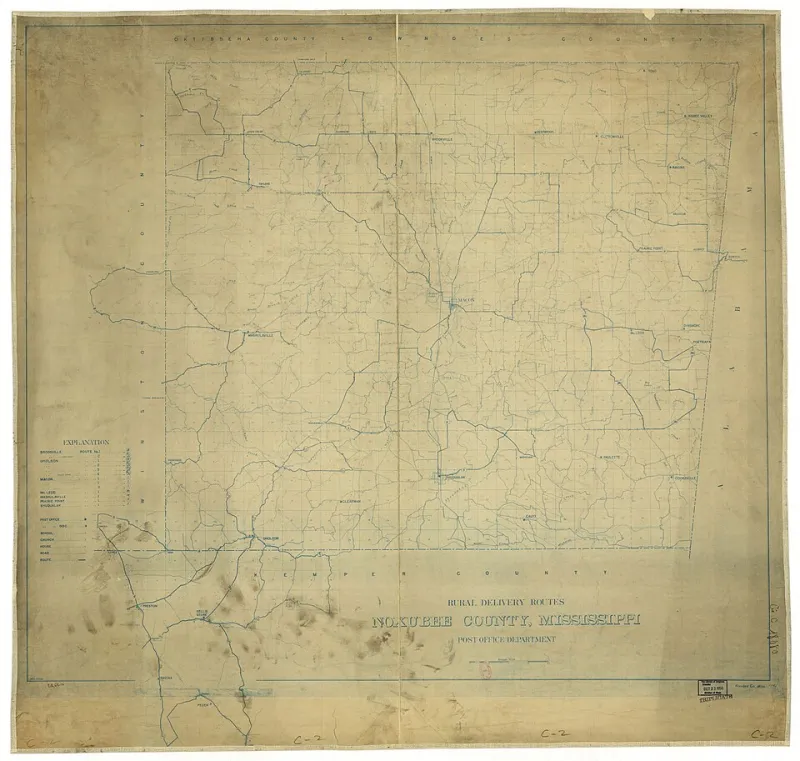
Photo: Etats-Unis. Post office department. Auteur du texte, Public domain, via Wikimedia Commons
The county agent was once a fixture of rural American life as dependable as the grain elevator. Today, in a growing number of counties, that fixture has quietly disappeared. A working paper posted this spring on a public repository — compiled from USDA staffing records, land-grant personnel directories, and state cooperative extension budgets — sketches the outlines of what its authors call the 'extension desert': a stretch of farm country where the nearest full-time agricultural educator is an hour or more down a two-lane road, if that office still exists at all.
Drawing the Map
The paper's methodology is straightforward but laborious. The authors geocoded every cooperative extension office in the contiguous United States, then calculated drive times from each county's populated places rather than its courthouse square. The results complicate the comfortable assumption that extension coverage tracks county lines.
Roughly 60 counties, concentrated in the High Plains, the Corn Belt's western fringe, and pockets of the inland Southeast, register average drive times exceeding 60 minutes to a staffed office. More troubling is the trend line: agent headcount in these counties has fallen faster than the national average over the past decade, in some cases by more than a third. Budget consolidation has been the primary driver. State legislatures, facing flat appropriations, have merged county offices into regional hubs — efficient on paper, isolating in practice.
The map is not merely a staffing audit. It is a portrait of an information gap with agronomic consequences. Farmers in desert counties report learning about new herbicide resistance findings, updated nutrient management guidance, or emerging disease threats later than their counterparts near university towns — sometimes a full season later.
What Farmers in the Gap Say
The paper's most revealing section draws on interviews with 34 producers across six desert counties. A Kansas dryland grower described driving 75 minutes to a regional office for a meeting that, in his words, 'might cover two things I can use and eight I can't.' A Mississippi Delta row-crop farmer said his most trusted source of new research is now 'the agronomist who sells me seed,' a candid admission about where expertise migrates when public channels thin.
Several interviewees described workarounds. One Montana rancher follows a handful of university researchers on social media and emails them directly with questions. Another grower relies on a co-op newsletter that, notably, already republishes summaries of unreviewed working papers — with a disclaimer, but without much fuss.
That last detail matters. Farmers, it turns out, are not allergic to preliminary science. They are accustomed to evaluating evidence under uncertainty; every planting decision is a wager on incomplete information. What they lack is access and translation, not judgment.
Preprints as a Delivery Mechanism
The authors' proposal is modest in cost and radical in implication: route open-access preprints and short plain-language summaries into the communication channels desert counties already use — rural electric co-op mailings, commodity group email lists, text-alert services, and radio ag-report slots.
The logic follows the medium. A 40-page journal article will not reach a grower mid-harvest, but a 200-word summary with a link, pushed through a trusted local newsletter, might. Several land-grant institutions have experimented with 'research briefs' in this format; the paper argues for treating them as infrastructure rather than outreach garnish.
Objections are predictable. Unreviewed findings carry risk, particularly for pesticide and veterinary applications where regulatory boundaries matter. The authors propose a tiered labeling system — flagged as preliminary, with the review status stated plainly — paired with editorial vetting by extension specialists who remain, even in desert counties, one phone call away even if not one mile.
A Modest Proposal With a Long Pedigree
There is historical irony here worth naming. The cooperative extension system was itself a radical act of open publishing — bulletins mailed free to any farmer who asked, no subscription, no gatekeeper. The preprint movement in agricultural science is less an innovation than a restoration, adapted to fiber-optic rather than parcel-post distribution.
The paper stops short of policy prescription, but the implications for the next Farm Bill's extension and research titles are hard to miss. If Congress funds a national repository of agricultural working papers — an idea already circulating in policy circles — the last mile into extension deserts is precisely the problem such a system should be built to solve.
The county agent may not return to every county that lost one. The knowledge, at least, no longer has to wait for the drive to shrink.