Germplasm Before Git: What Seed Exchanges Knew About Open Sharing a Century Early
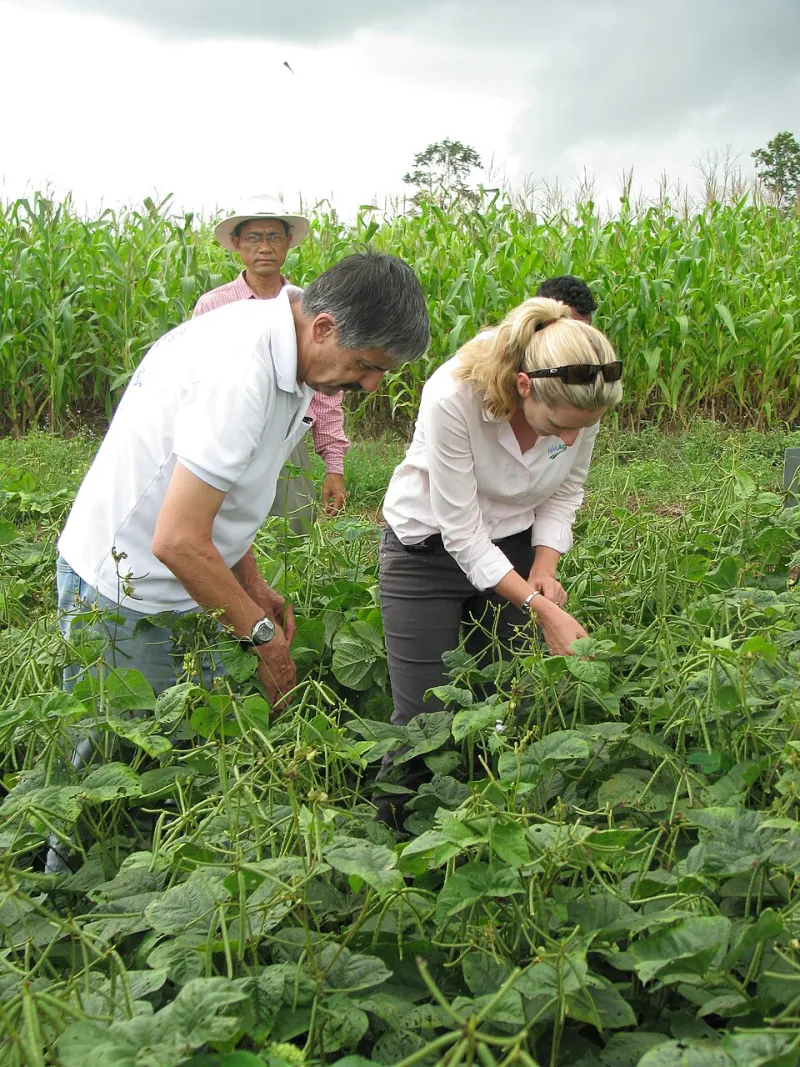
Photo: Rizozoda34, CC0, via Wikimedia Commons
The open-access movement in agricultural science has a habit of describing itself as revolutionary, as though the sharing of research materials ahead of formal publication were a recent innovation. Talk to a plant breeder, though, and the revolution starts to look like a rediscovery. For the better part of a century, the people who develop America's wheat, maize, and soybean varieties have operated a parallel distribution system — one built not on DOIs and embargoes, but on seed packets, trial notebooks, and a phone call to a colleague at a neighboring experiment station.
The Original Preprint Was a Seed Packet
Consider what actually circulates in these networks. A breeder at a land-grant university in Kansas, having observed promising Fusarium head blight resistance in a third-generation breeding line, will send a few grams of seed to counterparts in Nebraska, Oklahoma, and the Dakotas — often before any manuscript exists. Those colleagues plant the line in their own nurseries, record performance across environments the originator could never test alone, and send observations back. The material predates the paper.
This is, functionally, a preprint economy. Unpublished data moves quickly. Credit is tracked informally but rigorously — breeders keep meticulous records of who contributed which germplasm, and a failure to acknowledge a source line follows a scientist through a career. The system enforces norms that journal publishing struggles to enforce with legal agreements.
Consortiums as Living Repositories
The formalization of these habits produced some of agriculture's most durable institutions. The regional nurseries organized through USDA-ARS and the land-grant system — the uniform regional nurseries for wheat and barley among them — have pooled unpublished yield and disease data across states since the mid-twentieth century. Breeding consortiums for crops like barley and, more recently, public maize programs operate on a similar logic: shared material, shared trial data, shared authorship when the results are finally written up.
What makes these arrangements work is not anonymity or scale but trust and reciprocity. Participation is a form of reputation. Breeders who contribute lines and data gain access to everyone else's; those who hoard find themselves excluded from the next cycle of exchanges. The system is self-policing in a way that no editorial board can replicate.
What the Journal System Never Captured
Formal publishing, by contrast, has always arrived late to this exchange. A cultivar registration or a breeding paper typically appears years after the genetic material itself has been circulating, and the journal article captures only a fraction of the trial data accumulated along the way. Multi-environment yield trial results — the most decision-relevant evidence a grower or a fellow breeder can have — are frequently reduced to a single summary table, with the underlying observations never deposited anywhere.
The consequence is a persistent gap between what agricultural scientists know and what the record shows. A preprint server that simply reproduces the journal model, just faster, does not close that gap. The seed exchange networks suggest something more: that the unit of sharing in agriculture should include not just manuscripts but materials and raw trial data, released together.
Lessons for Formal Preprint Infrastructure
Three practices from the germplasm world deserve explicit translation into preprint infrastructure.
First, provenance as a first-class citizen. Breeders document pedigree — every line traces to its parents and contributors. Preprints could adopt the same discipline, linking datasets, germplasm accessions, and prior working papers so that the chain of contribution is machine-readable rather than buried in acknowledgments.
Second, reciprocity over gatekeeping. The seed networks reward contributors with access, not status alone. Repositories hosting agricultural preprints might experiment with tiered data sharing — contributors gain earlier or richer access to aggregated trial results — rather than relying solely on the honor of publication.
Third, distribution through trusted intermediaries. Seed exchanges work because the people passing material along are embedded in local networks — extension agents, regional nurseries, grower associations. A preprint deposited and forgotten serves no one; the lesson of the underground is that circulation requires messengers with standing in the community.
A Tradition to Build On, Not Replace
None of this argues against formalization. Informal exchange has real failures: material shared without documentation can vanish when a breeder retires, and handshake credit offers little protection when disputes arise. The value of a permanent, citable, open repository is precisely that it gives these decades-old practices a durable home.
But the direction of learning should be honest. Agricultural science does not need to be taught to share; it needs its existing sharing culture — trust-based, material, and fast — to be recorded, credited, and preserved. The preprint server that succeeds in this field will be the one that treats breeders not as converts to openness, but as its longest-standing practitioners.