Why Agricultural Science Missed the Open-Access Revolution — and How to Close the Gap
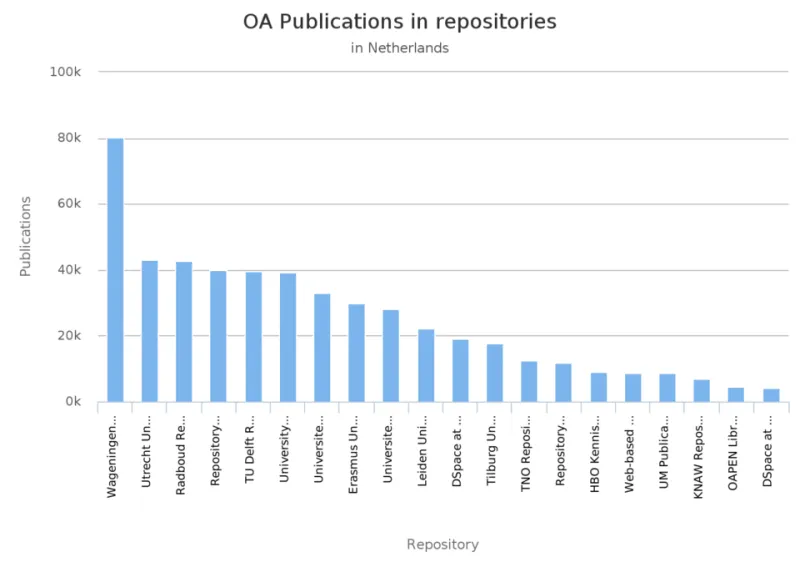
Photo: OpenAIRE (Open Access Infrastructure for Research in Europe), CC BY 4.0, via Wikimedia Commons
Agricultural research in the United States is, by a wide margin, a public enterprise. Land-grant universities, federal experiment stations, and USDA intramural programs produce the bulk of the nation's agronomy and food science literature. Yet when the open-science movement transformed physics in the 1990s and biomedicine in the 2010s, agriculture largely stood aside. The discipline's preprint adoption remains a fraction of what either field achieved at comparable maturity. The lag is not accidental, and understanding it is the first step toward fixing it.
Three Causes of the Delay
The first cause is cultural. Agronomy is a discipline of long feedback loops: multi-year field trials, seasonal planting windows, and variety evaluations that cannot be accelerated. Researchers internalized the patience their subject matter demanded, and the urgency that drove physicists to circulate results instantly never took hold. If the data takes three years to collect, the thinking went, what difference does a nine-month review make?
The second cause is consolidation. Agricultural publishing is dominated by a small number of commercial publishers controlling a disproportionate share of high-impact society journals. Unlike physics, where preprints evolved alongside a society-publishing ecosystem, ag researchers faced strong professional incentives — society memberships, awards, editorial boards — tied to submitting to the same consolidated titles. Open posting offered little career reward against that infrastructure.
The third cause is the tenure system at land-grant institutions. Promotion and tenure criteria at many colleges of agriculture still enumerate peer-reviewed journal articles as the primary evidence of scholarship, with extension and outreach weighted separately. A working paper, however widely read, often counts for nothing in a dossier. Biomedical faculty faced similar pressures, but the sheer volume of NIH-funded preprint adoption — and eventual funder signaling — eroded them. Agriculture never generated that critical mass.
Why the Status Quo No Longer Holds
The case for change has sharpened. Federal funders increasingly require public access to publications and data within fixed windows, and congressional attention to research transparency has grown. Meanwhile, the practical demands of the field — emerging pest outbreaks, drought adaptation, supply chain disruptions — have made nine-month review cycles a genuine liability, as recent policy debates over rapid evidence sharing have shown.
There is also an equity argument. Subscription barriers fall hardest on practitioners: county extension educators, small growers, researchers at under-resourced institutions, and international collaborators whose access is thinnest precisely where agricultural need is greatest. A discipline built on public investment should not gate its findings behind licenses the public cannot afford.
A Roadmap for Reform
Closing the gap does not require a revolution; it requires targeted interventions at three levels.
First, policy. Federal agencies funding agricultural research should follow the lead of biomedical funders by explicitly recognizing preprints in grant reporting and public-access compliance. A modest mandate — that federally funded manuscripts be deposited as preprints at or before journal submission — would shift norms faster than any voluntary campaign.
Second, institutions. Land-grant universities should amend tenure and promotion guidelines to count preprints and open datasets as scholarly products. A handful of institutions have taken tentative steps; a coordinated statement from the association of public land-grant universities would make reform the norm rather than the exception.
Third, societies. The professional societies that anchor agricultural publishing hold the leverage. By adopting open-access models — or at minimum, preprint-friendly submission policies — they can decouple scholarly credit from subscription paywalls while preserving the editorial quality their journals represent.
The Cost of Waiting
Skeptics will note that agriculture has open-access initiatives already, and this is true. But incremental adoption at the discipline's current pace means another decade of paywalled findings, delayed policy evidence, and avoidable duplication across the land-grant system. Biomedicine demonstrated that a funder nudge plus institutional recognition can transform norms within five years. Agriculture has the added advantage of being almost entirely publicly funded — the constituency for openness is, in principle, everyone.
The discipline that feeds the nation should not be the last one to share its findings with the nation. The tools exist. What remains is the will — at funding agencies, in faculty senates, and in the boardrooms of the societies that hold the keys.