Twelve Pages That Rewrote a Water Year: Inside the Almond Preprint California Couldn't Ignore
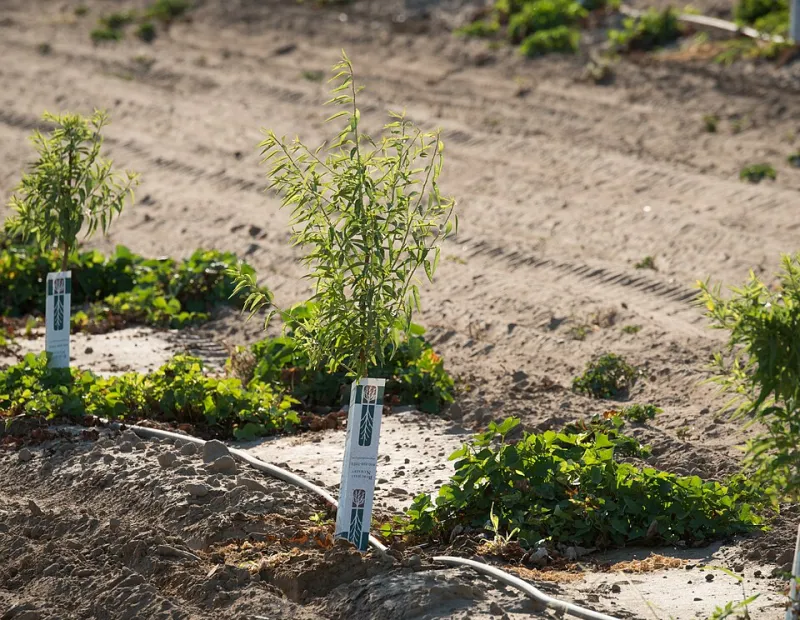
Photo: USDAgov, Public domain, via Wikimedia Commons
In February, a working paper landed on a preprint server with little fanfare: a twelve-page analysis of evapotranspiration rates in mature almond orchards across the San Joaquin Valley, drawing on three seasons of lysimeter data and satellite-derived canopy measurements. By April, its headline figure — a revised seasonal water requirement roughly eight percent below the statewide coefficient tables then in use — had appeared in irrigation district board packets, grower cooperative newsletters, and at least one comment letter filed with the State Water Resources Control Board.
The paper has since cleared peer review, essentially intact. But the sequence matters more than the verdict. California's most consequential water decisions this growing season were informed, in part, by numbers that no reviewer had formally blessed when they began circulating.
How the Numbers Traveled
The paper's author, a university crop-water researcher who asked not to be named before the journal version was finalized, described the diffusion as faster than anything in two decades of extension work. A Kern County farm advisor flagged the preprint in a late-winter newsletter. A water district hydrologist ran scenario models using the revised coefficients. By the time spring irrigation schedules were set, the figures had acquired the practical authority of accepted fact.
Nothing about this path was covert. The author posted the dataset alongside the manuscript, and the underlying lysimeter records had been publicly archived for a year. What spread was not a rumor but a document — one that happened to arrive ahead of the institutional machinery designed to evaluate it.
The Demand Side of Fast Science
Critics of preprints often frame the risk in terms of bad research escaping containment. The California case suggests a different dynamic: the risk of good research arriving before anyone has had time to disagree with it.
Almond water use is not an abstract quantity in a state under chronic drought conditions. An eight percent revision in orchard evapotranspiration, applied across hundreds of thousands of bearing acres, translates into real volumes of surface water and groundwater pumping. Irrigation districts that adopted the revised figures early gained flexibility; those that waited for the journal version may have allocated conservatively against a standard they suspected was stale.
Several district managers who cited the working paper acknowledged in interviews that they had not independently assessed its methodology. One described it as "the best number available this season" — a telling phrase. In water planning, the alternative to a preprint is rarely a peer-reviewed paper. It is last year's paper.
What the Formal Review Changed
The eventual peer review did contribute. Reviewers pressed for uncertainty intervals around the revised coefficients and flagged that the lysimeter sites skewed toward well-managed orchards on deeper soils. The published version now carries caveats that the February preprint lacked — caveats that, had they been available in March, might have tempered some district-level adoption.
This is the standard trade-off, and it is not an argument against preprints. It is an argument for reading them as what they are: provisional claims, however well-instrumented, moving through systems that rarely pause to check provenance.
A Policy Infrastructure Gap
California's water agencies maintain formal processes for adopting new evapotranspiration standards, and those processes exist precisely to prevent single studies from reshaping allocations overnight. Yet the informal channels — farm advisors, district engineers, consultant networks — operate on a different clock. When a preprint enters those channels, no gatekeeping mechanism applies.
The lesson for the agricultural research community is not that working papers should circulate more slowly. It is that the institutions consuming them need faster, more transparent ways to register provisional evidence. A district citing a preprint should say so, with a version number and date. Advisors summarizing unreviewed findings should label them as such. And repositories should make citation metadata easy to extract, so that the provenance of a number survives its journey from server to boardroom.
The almond paper will be remembered, if it is remembered at all, as a routine contribution to crop-water science. The more durable story is institutional: a state that runs its water policy on an annual clock met a research system that could finally match that pace — and discovered neither side had quite agreed on what happens next.