Version One Never Dies: What Happens in a Field When a Preprint Is Corrected
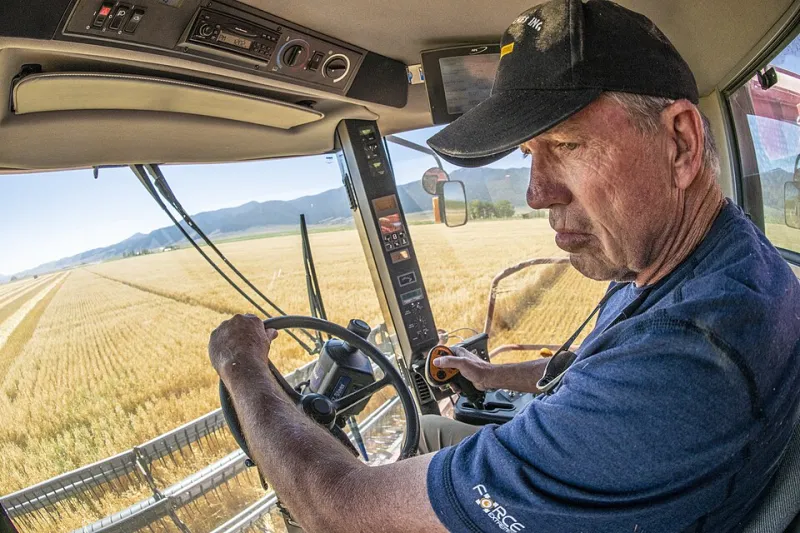
Photo: USDAgov, Public domain, via Wikimedia Commons
The text message went out on a Thursday in April, from a county agent to a group of about forty growers: "New research suggests we can shave 20 units of N and hold yield. Link attached." The link went to a preprint on AgriXiv, posted the previous week, reporting three years of nitrogen rate trials across eight sites in Illinois and eastern Iowa. The headline finding was a recommendation to reduce sidedress applications by roughly a fifth in high-residue corn-after-corn rotations.
The message was accurate. The paper said what the agent said it said. What changed, on 14 July, was the paper.
The Correction That Arrived After the Sidedress
The authors posted version two with a correction notice at the top. During a reanalysis, they had discovered that the economic partial budgeting in section four used a nitrogen price from the wrong year, and that one site's yield data had been entered in bushels per acre when the analysis expected dry tons for the silage portion of the rotation. The agronomic recommendation survived, slightly weakened; the economic argument for the reduction largely did not. The senior author, who agreed to discuss the episode on the record, described it as "the kind of error that peer review catches maybe half the time."
By 14 July, sidedress applications across most of the Corn Belt were finished. Whatever the growers on that text thread had done, they had done. And whatever most of them knew about the correction, they knew only if they happened to revisit a URL they had not opened in ten weeks.
How Versioning Is Supposed to Work
AgriXiv, like most preprint servers, assigns each posting a DOI and maintains a version history. Version two has its own DOI; version one remains permanently accessible, which is a deliberate archival choice and also, from a practical standpoint, the source of the problem. The server displays a banner on superseded versions, and it sends notifications to users who have signed up to follow a paper or an author. It does not notify people who merely clicked a link.
That is a reasonable design for a scholarly audience, which is trained to check version status and to treat a citation as a pointer to a specific object. It is a poor design for an audience that receives research as a forwarded message and acts on it within days.
"Our versioning is built for citational integrity, not for operational alerting," said one of the server's technical staff, who spoke about the platform's design rather than about any particular paper. "Those are different problems and we have only solved the first one."
The Alert That Never Came
Extension services have improvised around this gap for years, mostly without calling it improvisation. Several state programs maintain internal listservs where specialists forward notable preprints with a caveat attached. A few have begun keeping informal registers of papers they have cited in programming, so that if a correction appears, they can trace who heard what.
In this case, the county agent who sent the April message learned about the correction in August, from a colleague in another state, at a regional meeting. She sent a follow-up message to the same group. Roughly a third of the recipients responded. One wrote back that he had already bought his nitrogen and did not want to think about it.
"I did what I was supposed to do," she said. "I flagged it as unreviewed when I sent it. I told them it might change. But I don't have a system that tells me when it does, and neither do they. We're running a correction service out of our own memories."
Retraction Is Not the Hard Part
Public attention tends to focus on the dramatic case: a paper withdrawn, a finding collapsed, a scandal. Those are comparatively easy. Retractions are loud, they travel, and they are discussed. The common case is quieter and more consequential. A number changes. A caveat is added. An interpretation is softened. The conclusion still points in roughly the same direction, so nobody issues a press release, and the people who made decisions on the basis of the earlier version never learn that the basis shifted.
This is not unique to preprints. Journal corrections have the same problem, compounded by paywalls that keep the corrected version out of reach of anyone without a subscription. But preprints make it structural. The whole point of posting early is to reach people before the review process finishes, which means reaching them before the paper is stable.
What a Season-Aware System Would Look Like
Three modest changes would close most of the gap without altering the fundamental openness of the model.
First, correction notices could be pushed, not merely posted. Any user who has viewed a paper could be offered a one-click subscription to version alerts, with the default set to on for a defined window after posting. The technical cost is small; the policy question, about notifying people who never asked to be tracked, is real but solvable.
Second, preprint servers could publish a machine-readable change log, so that extension services and commodity groups can build their own watchlists without scraping pages. A correction that is legible to software travels further than a banner that is legible to a reader.
Third, and most important, extension programming that cites unreviewed work should record it as such in a durable place, not in an agent's inbox. A shared register of cited preprints, maintained at the state level and checked before each growing season, would cost a fraction of what a single misapplied recommendation costs a farm.
AgriXiv's existing tools are not wrong. They are calibrated to the norms of a literature that assumes deliberation. Agriculture often operates on a different clock, one set by soil temperature and the calendar rather than by citation practice. A correction posted in July is not late in the life of a paper. It is late in the life of a season, and the infrastructure has not yet learned to tell the difference.