The Docket Is Already Reading: Pollinator Preprints and the Pesticide Label Review
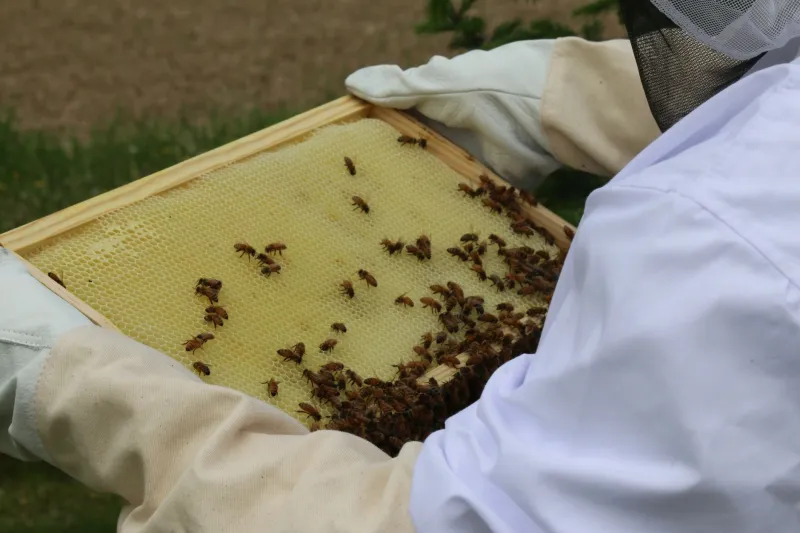
As of November 2026, the most consequential reading room in American agricultural policy may not be a journal's table of contents. It may be a public comment docket. There, working papers, technical annexes, and data summaries now sit alongside formal studies, agency memoranda, and industry submissions. The pollinator-health debate around pesticide labels is a clear example: a preprint can enter the regulatory record months before anyone knows whether a journal will accept it.
Consider the path of one recent AgriXiv working paper on native bee foraging and neonicotinoid exposure. The paper was posted in spring 2026 with a DOI, a data-availability statement, and an explicit label identifying it as a preprint. It had not completed peer review. By early summer, a conservation group had cited it in comments to the Environmental Protection Agency during a pesticide label review. An industry association responded in the same docket, disputing the study's field design and emphasizing its unreviewed status. The agency did not have to treat the preprint as settled science. It did have to recognize that the document was now part of the public record.
That is the shift worth noticing. The debate is no longer whether preprints belong in regulatory conversations. They are already there. The debate should be about how they are cited, how much weight they carry, and how they are archived so that later readers can see exactly what was before the agency at a given moment.
From Working Paper to Public Comment
The journey is often short. A researcher posts a manuscript to AgriXiv. The server indexes it, assigns a persistent identifier, and makes the version publicly available. Within days or weeks, a policy analyst searches for recent evidence on pollinator exposure, finds the working paper, and cites it in a comment letter. The comment is filed. The docket grows. Journal review may take months more.
This is not a failure of the system. It is a feature of a faster public conversation. Label reviews involve statutory timelines, court-ordered deadlines, and competing claims about risk. Waiting for a final journal version can mean waiting past the moment when a decision is made. Preprints give agencies and advocates a way to see emerging evidence while it is still emerging.
But speed creates an obligation. A preprint is not a verdict. It is a claim, a method, and a dataset offered for scrutiny. When it enters a docket, that character should remain visible. A comment that cites a preprint should say so plainly, identify the version, and explain what the commenter believes the paper does and does not establish.
Who Cites, Who Contests
The pollinator docket shows two familiar patterns. Conservation groups tend to use preprints to argue for precaution. If a working paper suggests that a pesticide formulation poses risks to foraging bees at field-relevant concentrations, advocates cite it as reason to tighten label language or require further study. Industry groups tend to use the same preprint to argue that the evidence base is unsettled. They point to unreviewed methods, small sample sizes, or confounded field conditions. Both sides are doing something rational: they are using the public record to advance an interpretation.
The agency's task is harder. EPA scientists must distinguish between a comment that cites a preprint and a formal study that has undergone agency review. They must weigh study design, exposure pathways, species sensitivity, and uncertainty. A preprint can inform that work without controlling it. The danger is not that regulators will mistake a preprint for a final study. The danger is that the docket will become a place where citations accumulate without context, leaving later readers unable to tell which claims were tested and which were merely asserted.
The Citation Problem
A useful regulatory citation to a preprint should do at least four things. It should identify the document as a preprint, not a published article. It should give the version and date, because preprints change. It should provide a persistent link or DOI. And it should disclose funding, conflicts, and data availability when those are known. These are not bureaucratic niceties. They are the minimum conditions for a reader to assess what was cited.
Agencies can also preserve a snapshot of the cited version in the docket. That matters because preprints are living documents. A working paper revised after public comment may reach different conclusions. Without an archived version, a later reader cannot reconstruct the evidentiary record that informed the comment. The docket should be a record of what was said, not a moving target.
What the Label Review Can Teach
The pollinator episode offers a broader lesson for agricultural policy. Open working papers are not a separate scientific universe. They are part of the same evidence stream that feeds extension services, congressional offices, state agriculture departments, and federal agencies. The question is how to make that stream legible.
One answer is procedural: require commenters who cite preprints to attach a short appraisal of the study's status and limitations. Another is institutional: ask AgriXiv and similar servers to provide versioned citation records that agencies can reference. A third is cultural: train policy analysts to read preprints the way they read any other working document, with attention to method, uncertainty, and revision history.
None of these steps requires agencies to accept preprints as final evidence. They simply require the record to be honest about what it contains. The alternative is worse: a docket in which preprints circulate informally, cited without context, disputed without clarity, and preserved only by accident.
The pesticide label fight will not be the last time a pollinator preprint matters. As federal reviews move forward in 2026 and beyond, more working papers will enter more dockets. The useful debate is not whether that should happen. It is how to cite them well, weigh them carefully, and archive them faithfully. A docket that can do that is not weaker for including preprints. It is more transparent about the evidence it is actually using.


